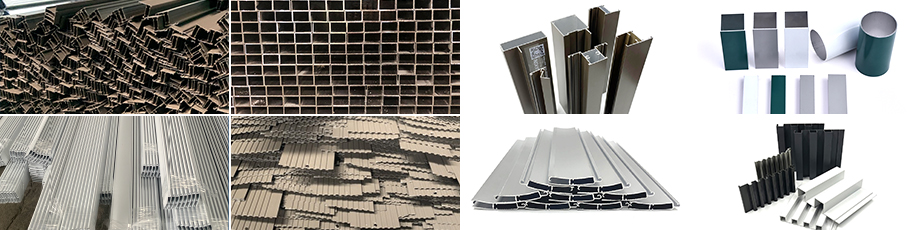
When manufacturers compare aluminum roller shutter slats, they usually look at the width, wall thickness, surface finish and price per ton. Weight per meter is sometimes treated as just another number on the quotation.
Actually, it tells you quite a lot.
Two slats may look almost the same in a product photo and even have the same covering height. But if their weight per meter is different, the aluminum content and cross-sectional structure are not exactly the same. This affects the material cost, the total curtain weight and, in some cases, the way the shutter works after assembly.
Weight per meter is simply the weight of one linear meter of profile, normally shown as kg/m.
It depends on the wall thickness, profile shape and how the aluminum is distributed inside the section. Extrusion tolerance also causes a small difference between the theoretical weight and the actual production weight.
So, when a drawing shows a theoretical weight of 0.50 kg/m, every finished piece will not necessarily be exactly 0.50 kg/m. A reasonable production tolerance is normal. What matters is whether the actual weight stays within the agreed range and remains stable from one batch to another.
We often see buyers comparing two quotations based only on the price per ton. This is understandable, but it does not always show the real difference.
For example, Supplier A may offer a lower price per ton, while Supplier B provides a profile with a different weight per meter or covering height. In this case, the number of meters obtained from one ton will also be different.
A lighter profile gives you more meters per ton. That sounds better at first. But it is still necessary to check where the weight has been reduced. Sometimes the difference comes from a more efficient cross-sectional design. Sometimes it comes from thinner walls.
That is why the price per ton should be checked together with the profile drawing, weight per meter and effective covering height. Otherwise, two quotations that appear similar may represent quite different products.
A small weight difference on one meter of slat may not look important. Once dozens of slats are assembled into a complete curtain, though, it adds up.
The approximate slat weight can be calculated as:
Slat weight per meter × Slat length × Number of slats
Suppose there is a difference of only 0.05 kg/m between two profiles. For a wide shutter using many slats, the final difference can be several kilograms.
This affects more than shipping cost. The manufacturer may also need to consider the shaft, spring, brackets and drive system. If the curtain is much heavier than expected, components selected using the original calculation may no longer be suitable.
For small shutters, the effect may be limited. For larger openings, it is worth checking carefully before production.
It is easy to assume that a heavier profile must be stronger. There is some logic behind this because a heavier slat normally contains more aluminum. Still, weight alone does not decide performance.
The cross-sectional design matters just as much. Material placed around the interlocking area or other critical parts may improve rigidity more effectively than simply making the whole profile heavier.
The alloy temper, wall-thickness distribution, slat width and finished shutter size also have an effect. A heavier profile with a poor design is not necessarily the better choice. And a lighter profile is not necessarily low quality.
The useful question is not “Which one is heavier?” It is “Is this weight and structure suitable for the shutter we are producing?”
Weight per meter is also useful for repeat orders.
If the same profile becomes noticeably lighter or heavier in a later shipment, the wall thickness or extrusion dimensions may have changed. That can lead to changes in interlocking, curtain weight and material calculation.
Not every small variation means there is a quality problem. Aluminum extrusion always has production tolerances. But the variation should be controlled and should match what the buyer and supplier agreed before production.
For manufacturers who use the same profile regularly, keeping a record of the sample weight and batch weight is a simple way to monitor consistency.
Once the weight per meter is known, buyers can estimate how much profile length they will receive from an order.
If a slat weighs 0.50 kg/m, one metric ton theoretically represents around 2,000 meters. The actual shipment calculation still needs to consider production tolerance, packaging and the mix of profiles in the order, but this estimate is already useful.
A distributor can use it to plan warehouse stock. A shutter manufacturer can estimate how many curtains can be produced. It also makes it easier to compare the material consumption of different slat designs.
Before placing an order, ask for the profile drawing and theoretical weight per meter. The supplier should also confirm the covering height, alloy temper and acceptable weight tolerance.
For a new design, testing a physical sample is still the safer approach. A drawing can show dimensions, but it cannot fully show how smoothly the slats interlock or how the profile behaves during actual assembly.
If the sample works correctly, record its weight and dimensions. These figures can then be used as a reference for future production.
Weight per meter may look like a small technical detail, but it connects directly to purchasing cost, material calculation and the final curtain weight.
It should not be checked alone, and it should not be used as the only measure of quality. But when it is considered together with the cross-sectional design, wall thickness and application, it gives manufacturers a much clearer picture of what they are buying.
Huixin Aluminum manufactures extruded aluminum roller shutter slats, guide rails and bottom rails for wholesalers and shutter manufacturers. If you already have a drawing or physical sample, we can check the profile dimensions, theoretical weight and extrusion requirements before preparing a quotation.